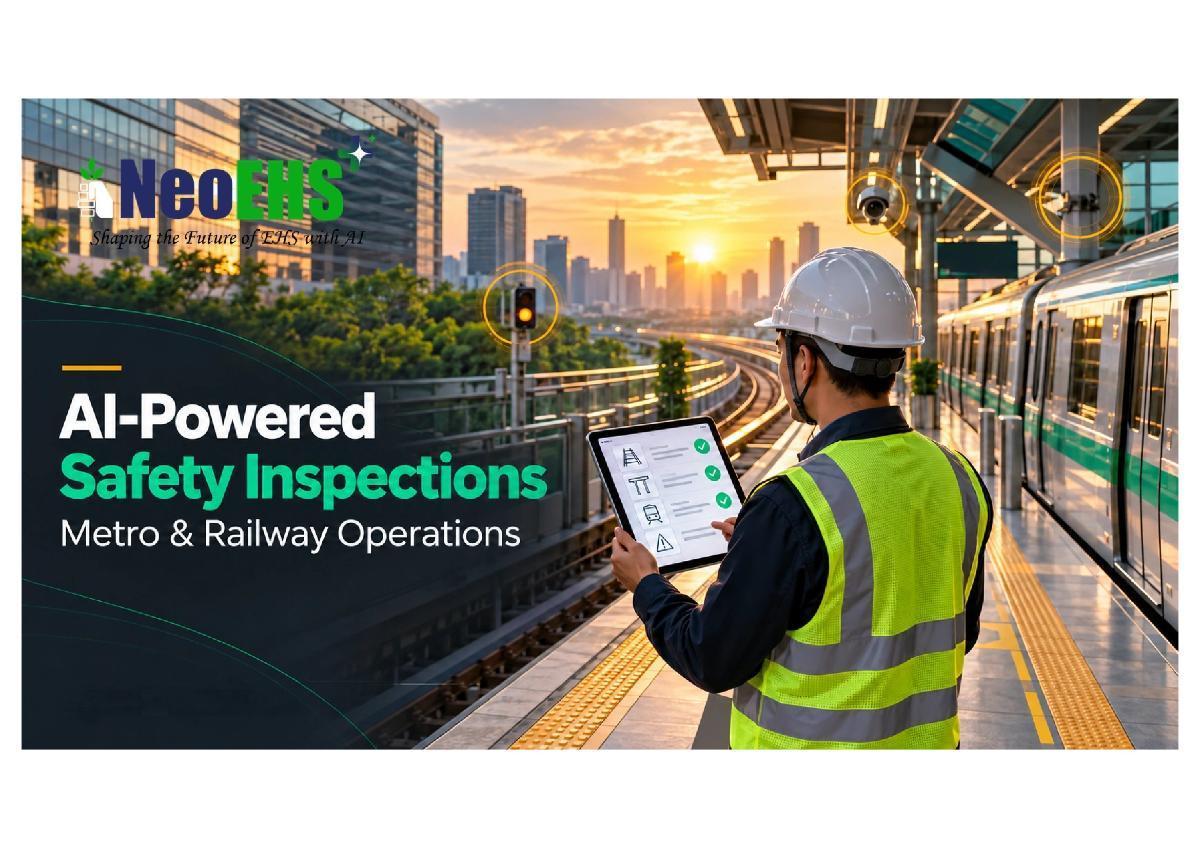
Metro and Rail Safety - AI-Powered Inspections for ZERO HARM Operations
AI-Powered Safety Inspections for Metro and Railway Operations
Find the recurring issues. Give every action an owner. Verify that the problem has been resolved.
A station inspection is complete. The checklist is submitted, photographs are attached and the dashboard shows another task finished. Yet the same obstruction appears again the following week.
For a metro or railway operator, that is the question worth investigating: why did a completed inspection fail to produce a lasting improvement?
Digital records make findings easier to track. AI can help teams examine those records together, recognise repeated problems and decide where further attention is needed. The operational value comes when that insight leads to a timely response and an effective corrective action.
What are AI-powered safety inspections?
AI-powered safety inspections combine structured digital inspections with AI-assisted analysis of findings, evidence and action history. They help safety teams identify recurring themes, review priorities and connect observations across locations. Inspectors remain responsible for checking conditions and authorised personnel remain responsible for safety decisions.
In metro and railway operations, the approach can support workplace EHS inspections at stations, depots, workshops, maintenance facilities and authorised work areas. It should sit alongside the operator's approved technical inspection and maintenance programmes.
A general EHS application does not certify track condition, establish signalling integrity or authorise train movement. Those functions require their own engineering processes, competent personnel and applicable assurance arrangements.
Digital checklists and AI serve different purposes
A digital checklist structures the inspection: which questions to ask, what evidence to collect and where to send the findings. Automation can then route an action or send an overdue reminder using predefined rules.
AI adds a different capability. It can help recognise that “materials near emergency exit”, “blocked escape route” and “storage in exit corridor” may describe a related issue, even though inspectors used different words.
That distinction matters when choosing software. A digital form or an automatic notification is useful, but it is not necessarily AI. Ask to see how an AI feature improves an actual inspection decision, and how its suggestions are reviewed.
Where should metro and railway teams focus inspections?
The inspection programme should reflect the operator's risks, work activities and mandatory requirements. A single checklist copied across every location rarely captures the differences between a passenger station and a maintenance workshop.
Operational area Examples of EHS inspection topics Useful follow-up
Stations and public areas Access routes, housekeeping, visible barriers and emergency-equipment accessibility Assign local ownership and review repeated findings by exact location
Depots and workshops Pedestrian segregation, storage, spill response, work-area controls and equipment-access arrangements Connect observations to responsible maintenance and contractor teams
Authorised trackside work areas Worksite arrangements and evidence required by the approved safe system of work Escalate concerns through the operator's established access and protection procedures
Contractor work areas Housekeeping, task controls, relevant authorisations and coordination with adjacent activities Track actions against the contractor and affected work package
Environmental and welfare facilities Waste segregation, chemical storage, drainage, welfare conditions and exposure-control records Route findings to the appropriate facilities, environmental or occupational-health lead
These are planning examples, not a complete technical checklist. Required inspection frequencies and acceptance criteria must come from the applicable operating arrangements and competent specialists.
Five practical ways AI can support inspection teams
1. Find repeated issues across differently worded reports
One inspector records “poor housekeeping”. Another describes a narrow walkway. A third photographs materials outside a marked storage area. Reviewed separately, the reports may seem unrelated.
AI-assisted text analysis can suggest a common theme for a human reviewer to confirm. The next question becomes more useful: is there a recurring storage problem that individual clean-up actions have not resolved?
2. Help reviewers prioritise attention
Inspection teams can consider the seriousness of a finding, the people exposed, previous recurrence and unresolved actions when setting priorities. AI may help bring those factors together and highlight records requiring review.
A recommendation should show the evidence behind it. Fixed escalation rules for urgent concerns must continue to apply, regardless of the AI score. Inspectors need a clear route to raise a concern immediately.
3. Connect inspection findings with incident history
A finding may have greater significance when viewed alongside an earlier near miss in the same area. Reviewing both records can help teams decide whether previous corrective action addressed the underlying problem.
Where records are appropriately linked, inspection analysis can inform investigation and learning. Explore NeoEHS Incident Management for related reporting and corrective-action workflows.
4. Add visual monitoring for defined use cases
Computer vision can provide an additional input for selected observations, such as missing PPE or entry into a configured restricted zone. It needs validation for the actual camera position, lighting, distance and environment.
A photograph cannot reveal every hazard. Hidden defects, electrical state and structural integrity require appropriate technical assessment. An absence of alerts does not establish an absence of risk.
NeoEHS AI-Powered Computer Vision describes visual safety-monitoring applications that can be evaluated alongside an inspection programme.
5. Support better management reviews
AI-assisted summaries can help reviewers explore recurring themes across a large set of findings. Each summary should remain traceable to the underlying records so a supervisor can check the context.
Patterns should prompt investigation rather than automatic conclusions. More findings at one depot may reflect better reporting, different work exposure or a more thorough inspection programme.
From finding to verified improvement: the inspection workflow
NeoEHS Inspection Management describes capabilities including configurable checklists, mobile evidence capture, action tracking, approvals and inspection analytics. These provide a foundation for a connected process:
Plan: Define the inspection scope, responsible person, approved checklist and required frequency.
Inspect: Examine the actual conditions and record clear findings against the right location or asset.
Review: Assess significance, confirm the context and initiate the required response. Use AI suggestions as supporting information.
Assign: Give each action a named owner, due date and escalation route.
Complete: Record what was done and provide relevant evidence.
Verify: Check that the response is suitable before accepting closure; review effectiveness later where necessary.
Learn: Look for recurrence and improve the arrangements that allowed the issue to develop.
Offline capture can be useful where connectivity is limited. However, a locally saved report may not have reached anyone else. Test synchronisation behaviour and retain the operator's established urgent communication channels.
An example: why the same access route keeps becoming obstructed
The following is an illustrative scenario, not a reported NeoEHS customer result.
During routine depot inspections, supervisors repeatedly find materials encroaching on a pedestrian route. Each time, someone removes the materials and closes the action.
AI-assisted analysis groups several differently worded findings from the same area. A supervisor reviews the source records and notices that the reports tend to follow a particular delivery activity.
The team investigates the work arrangements and discovers that the designated temporary storage area is poorly positioned for that delivery. It reviews the layout and responsibilities, implements an agreed change and schedules follow-up checks.
The important outcome is not the AI grouping itself. It is the team's decision to examine why the issue recurred and verify whether the revised arrangements work.
Which inspection KPIs are worth tracking?
Inspection volume alone says little about the effectiveness of the programme. Pair completion measures with evidence of action and follow-up:
On-time inspection completion: inspections completed by their due date divided by inspections due in the same period.
Overdue significant findings: open findings past their agreed due date, separated by severity and location.
Time to initial response: elapsed time from reporting to the first documented response, assessed by priority.
Verification backlog: completed actions awaiting the required check before accepted closure.
Repeat findings: recurrence of the same defined issue at the same location or asset within an agreed period.
AI review quality: sampled incorrect suggestions, missed relevant issues and reviewer overrides, using an agreed review method.
Use consistent definitions and distinguish an action completed from a control shown to be effective. Do not reward low reporting counts without understanding what they mean.
How to introduce AI-powered inspections responsibly
Begin with one representative station, depot or inspection process. Identify a specific problem to solve, such as repeated findings that are difficult to recognise across separate reports.
Standardise location names, issue categories and ownership before adding complex analysis. Ensure records distinguish between inspector observations, AI suggestions and decisions approved by people.
Test the system against historical examples and live pilot records. Include difficult conditions, not only clear photographs or neatly written reports. Review missed issues as well as false alerts, and make it easy for inspectors to correct a suggestion.
Set appropriate access controls, retention arrangements and privacy safeguards for images and worker information. Confirm supported mobile and offline functions in the deployment being considered.
Expand after the pilot demonstrates better review or follow-up. Predictive analysis should never be used to silently reduce mandatory inspection frequencies.
How NeoEHS supports metro and railway inspection programmes
NeoEHS is an AI-powered Environment, Health and Safety software platform. Its inspection offering combines digital checklists, evidence capture, corrective-action workflows and analytics; its Metro & Rail EHS solution places inspections within broader operational safety processes.
Start a discussion with the work your team needs to manage: the inspection types, locations, responsibilities, escalation rules and evidence required for closure. Confirm which AI functions, integrations and device capabilities are included in the proposed deployment.
Bring a real inspection checklist and an anonymised recurring finding to your NeoEHS demonstration. Follow the record from capture through review, action assignment and verification. That is a useful way to assess how the system would support your team.
Visit www.neoehs.com or contact info@neoehs.com.
Frequently asked questions
What is the difference between digital and AI-powered inspections?
Digital inspections structure data capture and workflow. AI-powered inspections add analysis that can help identify patterns, related findings and priorities. Automated reminders alone do not make a system AI-powered.
Can AI replace a qualified railway inspector?
No. AI can assist with reviewing information, but competent inspectors and authorised personnel retain responsibility for required checks and decisions.
Can a general EHS platform detect rail cracks or certify signalling equipment?
Those tasks require specialised inspection technology, validated methods and engineering assurance. They should not be assumed to be capabilities of a general EHS inspection platform.
Can inspections be completed without internet access?
NeoEHS lists mobile and offline inspection support. Confirm the supported functions, evidence limits and synchronisation behaviour for your deployment. Offline capture does not guarantee immediate notification to a supervisor.
How should an operator measure improvement?
Review timely responses, verification backlogs, recurring findings and the quality of inspection coverage. Compare like-for-like periods and work exposure rather than relying only on inspection counts.
Does AI-powered inspection software guarantee compliance or prevent every incident?
No. It supports records, reviews and follow-up. Results depend on the inspection programme, information quality, competent decisions and effective controls in practice.
It is ok to contact this poster with commercial interests.
Call seller