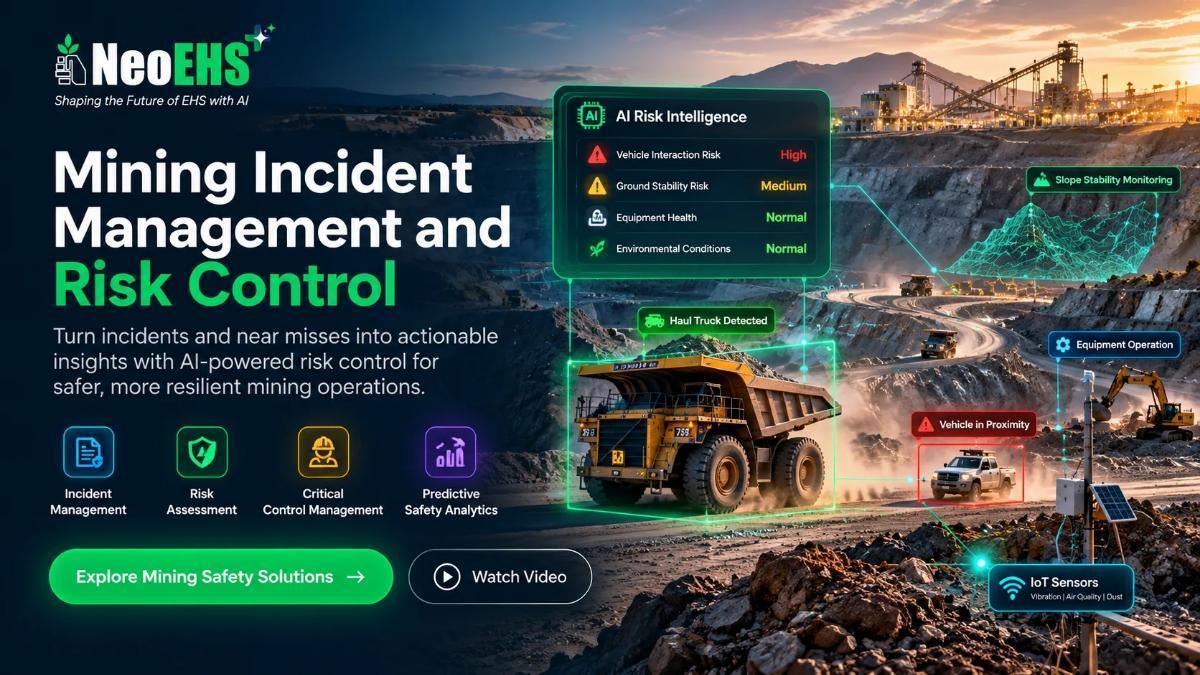
Mining Incident Management and Risk Control: From Reactive Response to Predictive Prevention
Why mining safety requires a different approach
Mining is one of the most demanding environments for occupational health and safety management. Unlike many conventional workplaces, mining operations involve constantly changing ground conditions, large mobile equipment, explosives, high-energy systems, remote work locations and multiple contractors working simultaneously.
A hazard that appears manageable during the morning shift may become critical later because of changing weather, equipment movement, blasting activities or ground instability.
For mining companies, the challenge is not simply recording incidents. It is understanding why they occur, verifying whether critical controls are working and identifying warning signs before workers are exposed to serious harm.
This is where mining incident management and risk control must work together.
A modern approach connects incident reporting, near-miss management, hazard identification, risk assessment, inspections, Permit to Work, investigations and corrective actions in a single operational safety process.
AI-powered EHS platforms such as NeoEHS can help mining organizations connect this information, identify recurring risk patterns and support more timely preventive decisions.
What is mining incident management?
Mining incident management is the structured process of reporting, responding to, investigating and learning from accidents, near misses, unsafe conditions and high-potential events across mining operations.
It includes immediate response, evidence collection, root cause analysis, corrective and preventive actions (CAPA), management review and verification that implemented controls are effective.
Mining incident management should cover both events that cause harm and events that reveal a serious weakness in safety controls.
For example, a haul truck narrowly avoiding a collision with a light vehicle may not result in an injury. However, the event could expose deficiencies in traffic segregation, visibility, communication or vehicle proximity controls.
If the organization records the event but does not investigate those weaknesses, the underlying risk remains.
A strong incident management process converts such events into actionable safety intelligence.
What is risk control in mining?
Mining risk control is the application and verification of measures designed to eliminate hazards or reduce the likelihood and consequences of harmful events during mining activities.
Controls may include mine design, ground support, traffic separation, equipment guarding, isolation systems, ventilation, exclusion zones, operating procedures and competency requirements.
Risk control is not complete when a control is merely documented in a risk assessment.
The critical question is:
Is the control present, effective and functioning under actual operating conditions?
A mining operation may have an approved traffic management plan, but if haul-road intersections have poor visibility or light vehicles routinely enter heavy-equipment zones, the documented control may not reflect operational reality.
Effective risk management therefore requires regular verification of controls at the worksite.
Why traditional incident reporting alone is insufficient
Many mining organizations already have incident registers, inspection checklists, risk assessments and investigation procedures.
The problem arises when these processes operate independently.
Consider a typical sequence:
An operator reports poor visibility at a haul-road intersection.
A supervisor records a near miss involving a light vehicle.
An inspection identifies damaged warning signage.
A risk assessment recommends improved traffic separation.
A corrective action is closed after the signage is replaced.
Each activity may be completed correctly within its own system.
However, unless the information is connected, management may fail to recognize that the same intersection has experienced repeated exposure to vehicle interaction risk.
The organization may also overlook whether the corrective action addressed the underlying traffic design problem.
Closing an incident report is not the same as controlling the risk that caused it.
This distinction is central to effective mining safety management.
Seven critical mining risks that incident management must address
Mining operations should prioritize risks based on their specific activities, geological conditions, equipment, workforce exposure and potential severity.
The following categories deserve particular attention.
Critical risk
Typical exposure
Important controls
Mobile equipment interactions
Haul trucks, loaders, light vehicles and pedestrians
Traffic segregation, proximity detection, visibility, exclusion zones
Ground instability
Open-pit walls, underground roofs and unsupported ground
Geotechnical assessment, ground support, monitoring, exclusion
Blasting and explosives
Misfires, flyrock, premature entry, explosive handling
Blast plans, controlled access, clearance, authorization
Energy isolation
Electrical, hydraulic, pneumatic and stored energy
LOTO, isolation verification, zero-energy testing
Confined and hazardous atmospheres
Underground workings, tanks, enclosed plant areas
Ventilation, gas monitoring, atmospheric testing, rescue readiness
Working at height
Conveyors, crushers, platforms and maintenance structures
Engineered access, edge protection, fall prevention
Fire and hazardous substances
Fuel storage, conveyors, equipment, chemical handling
Fire protection, containment, inspections, emergency planning
These are not interchangeable risks. Each requires appropriately designed preventive and mitigating controls.
For high-consequence mining hazards, organizations should distinguish between routine procedural requirements and critical controls whose failure could contribute to a fatal or catastrophic event.
Building an integrated mining incident management lifecycle
A reliable mining safety system should connect the full incident lifecycle.
CONNECTED INCIDENT-TO-PREVENTION LIFECYCLE
01
Report
02
Respond
03
Investigate
04
Identify Causes
05
Implement CAPA
06
Verify Controls
07
Analyze Trends
08
Prevent Recurrence
1. Report incidents and near misses immediately
Workers and contractors should be able to report incidents, hazards and unsafe conditions from the field without unnecessary administrative delays.
Mobile reporting can capture photographs, location details, equipment information, event descriptions and immediate actions.
In remote mining areas, offline data capture can be particularly useful where connectivity is limited.
2. Prioritize the immediate response
Not every event requires the same escalation.
A first-aid event, a high-potential near miss and a major ground-control incident have different response requirements.
Incident classification should consider actual consequences, credible potential consequences and the effectiveness of existing controls.
3. Investigate beyond individual error
An effective investigation should examine the conditions that allowed the event to occur.
For example, when a maintenance worker enters an unsafe area, the investigation should not stop at a conclusion of procedural noncompliance.
It should consider supervision, equipment design, access arrangements, isolation procedures, training, workload and organizational factors.
Structured techniques such as the 5 Whys, Fishbone Analysis and Fault Tree Analysis can support investigation teams.
NeoEHS provides a dedicated Incident Management Software solution for connecting incident records, investigation activities and corrective actions.
4. Assign corrective and preventive actions
Corrective actions should address verified causes rather than merely closing investigation findings.
Where practicable, engineering and other higher-order controls should be considered before relying primarily on training, reminders or additional procedures.
Each action needs an owner, completion date, evidence and verification requirements.
5. Verify that risk has actually been reduced
A corrective action should not be considered effective simply because a task has been marked complete.
For example, after redesigning a haul-road intersection, the mine should verify whether the changes have improved visibility, traffic separation and compliance under real operating conditions.
6. Learn across sites, contractors and shifts
Mining companies operating multiple pits, processing plants or underground sections should be able to identify repeated hazards across locations.
Lessons learned should reach the people and operations exposed to similar risks.
Critical Control Management: The missing link between incidents and prevention
One of the most valuable improvements mining companies can make is to connect incident management with Critical Control Management (CCM).
CCM focuses on identifying the controls essential for preventing or mitigating material unwanted events and verifying their effectiveness.
Consider a vehicle–pedestrian collision scenario.
The unwanted event is a collision between mobile equipment and a person.
Critical controls may include physically separated pedestrian routes, effective traffic management, functioning proximity warning systems and controlled access to operational zones.
The organization should establish what each control must achieve, how it will be verified, who is responsible and what happens if it fails.
A digital EHS system can support this process by connecting:
Critical Risk → Critical Control → Verification Activity → Failed Control → Corrective Action → Reverification
This allows mining leaders to examine not only incident counts but also whether important preventive controls are functioning.
How AI can improve mining incident management
Artificial intelligence can provide additional value when it analyzes connected, relevant and sufficiently reliable operational safety information.
Its role is to support human judgment, not replace competent mining professionals or established engineering controls.
Identify recurring incident patterns
AI-assisted analytics can examine incident descriptions, near misses, observations and historical findings to identify repeated event types or locations.
For example, recurring maintenance-related near misses involving the same conveyor system may indicate weaknesses that deserve further investigation.
Prioritize emerging risk signals
Changes in inspection findings, failed control checks, overdue actions or exposure patterns can help identify operational areas requiring management attention.
Such signals should trigger review and verification rather than be treated as definitive predictions of an accident.
Support incident investigation
AI can assist with organizing evidence, identifying similarities with previous events and highlighting potential contributing factors.
Investigation conclusions must still be validated by qualified personnel.
Improve corrective action monitoring
Connected analytics can highlight recurring overdue actions, repeated findings and corrective measures that have not demonstrated sustained effectiveness.
Connect computer vision and IoT observations
Where properly deployed and validated, computer vision and connected sensors can contribute additional evidence about PPE use, restricted-zone entry, vehicle interactions or changing environmental conditions.
However, these systems require suitable coverage, calibration, governance and human oversight.
Mining risk assessments: Connecting HIRA, JSA and operational controls
Risk assessment should remain closely connected to daily mining activities.
A mine may conduct formal risk assessments for high-level operational hazards while using task-level Job Safety Analysis (JSA) or Job Hazard Analysis (JHA) for specific work.
Both approaches have value.
A site-level assessment may identify the risks associated with crusher maintenance, while a task-level assessment identifies the specific hazards of removing guards, isolating equipment and working near stored energy.
The assessment should connect to the actual controls required before work begins.
NeoEHS offers Risk Management Software for structured risk identification, assessment, control planning and connected safety workflows.
Digital Permit to Work for high-risk mining activities
Permit to Work (PTW) is especially important for nonroutine and high-risk activities, including:
Electrical maintenance and isolation
Hot work near combustible materials
Confined-space entry
Working at height
Excavation and ground-disturbance activities
Equipment maintenance involving stored energy
Simultaneous operations involving contractors
A permit should not function as an isolated approval form.
It should reference the relevant hazards, risk assessment, isolation requirements, competency checks, authorizations and worksite conditions.
For example, maintenance on a conveyor may require verified isolation, confirmation that stored energy has been released, suitable access controls and authorization before work begins.
The NeoEHS Permit to Work Software provides a digital approach to managing work authorization and related safety controls.
The importance of mobile safety inspections in mining
Mining workplaces are geographically dispersed and operationally dynamic.
Inspection teams may need to examine haul roads, workshops, processing plants, conveyor systems, underground workings and contractor work areas.
Paper-based inspections can delay the visibility of critical findings, particularly when information must be transferred manually into a separate action register.
Mobile inspection workflows can help capture findings, photographs, location information and assigned actions closer to the point of observation.
The NeoEHS Inspection Management Software supports digital inspections and connected follow-up processes.
The real value comes when inspection findings are linked to hazards, risk assessments, incidents and corrective action verification.
Contractor safety: Managing risk across multiple employers
Mining operations frequently depend on contractors for drilling, blasting, equipment maintenance, construction, transport and specialist services.
Contractor safety should not operate as a separate administrative process.
Contractors need appropriate induction, competency verification, risk communication, work authorization and supervision.
Incident and near-miss information should be available to authorized teams responsible for identifying common risks across employers and work areas.
For example, if several contractors experience similar isolation failures, the mine should examine whether a site-wide control weakness exists rather than treating each event independently.
Mining safety KPIs: What should management measure?
Incident frequency rates are important, but they provide only part of the picture.
A balanced mining safety dashboard should include both lagging indicators, which describe events that have occurred, and leading indicators, which help evaluate preventive activity and control effectiveness.
Indicator
Type
Management value
Recordable incident rate
Lagging
Tracks recorded injury outcomes
High-potential incidents
Lagging/event-based
Highlights serious potential consequences
Repeat incident themes
Lagging/trend
Identifies recurring weaknesses
Critical control verification completion
Leading
Measures whether planned checks are performed
Critical control failure rate
Leading
Identifies ineffective or unavailable controls
Overdue high-priority CAPA
Leading
Highlights unresolved safety actions
Permit compliance findings
Leading
Reveals work authorization weaknesses
Contractor competency compliance
Leading
Monitors workforce readiness
Repeated inspection findings
Leading/trend
Indicates potentially ineffective interventions
These measures must be interpreted in context. An increase in near-miss reporting, for example, may reflect better reporting culture rather than worsening safety performance.
Management should focus on the quality of risk information and verified control effectiveness—not simply improving dashboard numbers.
Practical mining scenario: Preventing a haul-truck collision
Consider a hypothetical open-pit mine where several near misses have occurred between haul trucks and light vehicles.
Traditional response: Each event is recorded, drivers are reminded of traffic rules and supervisors conduct additional toolbox talks.
Connected risk-control response: The safety team combines near-miss reports, vehicle movement information, inspection findings and traffic risk assessments.
The investigation identifies poor intersection visibility, inconsistent separation and repeated access-control failures.
The mine reviews the traffic layout, strengthens engineering controls, verifies the effectiveness of proximity systems where applicable and assigns measurable follow-up inspections.
Management then monitors whether the relevant critical controls are consistently functioning.
AI-assisted analysis may help reveal the repeated pattern earlier, but the preventive improvement comes from implementing and verifying effective controls.
This is the difference between managing incident records and managing operational risk.
How NeoEHS supports connected mining safety
NeoEHS is an AI-powered Environment, Health and Safety management platform designed to connect core safety processes and provide greater visibility into operational risk.
For mining organizations, its relevant capabilities include:
Incident and near-miss reporting, investigations and CAPA
Hazard identification and risk assessment
Digital inspections and audits
Permit to Work and related operational controls
Contractor safety and workforce competency
Mobile and offline field reporting
EHS dashboards, analytics and AI-assisted insights
Integration opportunities for computer vision and IoT data
Environmental management and ESG-related processes
The strategic advantage is the ability to connect safety information across operational processes rather than manage every activity as an independent record.
Specific AI, computer vision, IoT and integration capabilities should be confirmed against the proposed deployment and mine operating environment.
A practical roadmap for mining companies
Mining organizations do not need to digitize every safety process simultaneously.
A phased approach is often more manageable.
Phase 1 — Establish incident and hazard visibility. Standardize incident classification, near-miss reporting, mobile evidence collection and corrective action ownership.
Phase 2 — Connect risk and critical controls. Link material unwanted events, critical controls, verification activities and control failures.
Phase 3 — Integrate operational safety. Connect inspections, PTW, contractor safety and competency information.
Phase 4 — Introduce advanced analytics. Use validated safety data to identify recurring patterns, exposure trends and emerging concerns.
Phase 5 — Strengthen continuous improvement. Verify corrective action effectiveness and share lessons across sites, shifts and contractors.
The objective is not merely a paperless mine. It is a mining operation where safety information leads to earlier, better-informed decisions.
Frequently asked questions
What is mining incident management software?
Mining incident management software is a digital system for reporting, investigating, tracking and analyzing accidents, near misses, high-potential incidents and unsafe conditions in mining operations. It helps coordinate corrective actions and preserve information for operational learning.
What is the difference between incident management and risk management in mining?
Incident management addresses events that have occurred or nearly occurred. Risk management identifies potential hazards, evaluates exposure and establishes controls before an event. The two processes are most effective when incident findings continuously inform risk assessments and control verification.
How can AI help prevent mining incidents?
AI can analyze connected safety records and operational data to identify recurring patterns, anomalies and emerging risk indicators. These insights can support preventive action, but AI cannot guarantee that an incident will be predicted or prevented.
What are critical controls in mining?
Critical controls are measures considered essential for preventing or mitigating material unwanted events, such as serious vehicle collisions, ground failures or uncontrolled energy releases. Their performance should be defined, verified and monitored.
What are the most important mining safety KPIs?
Important measures include high-potential incidents, recordable injuries, critical control failures, verification completion, overdue high-priority corrective actions, repeat findings and relevant contractor safety indicators. The right combination depends on the mine's risk profile.
Why is mobile incident reporting important in mining?
Mobile reporting enables workers and supervisors to record events and evidence closer to where they occur. Offline functionality is valuable in remote or underground areas with unreliable connectivity.
Can one EHS platform manage both surface and underground mining?
An integrated EHS platform can support shared incident, risk, inspection, permit and compliance workflows across surface and underground operations. However, each mine requires site-specific hazard assessments, controls, configurations and appropriate technology integration.
How does NeoEHS support mining risk control?
NeoEHS connects incident management, risk assessment, inspections, audits, PTW, contractor safety and corrective actions within an enterprise EHS environment. AI-assisted analytics can support identification of trends and emerging safety concerns.
Conclusion: From recording incidents to controlling risk
Mining safety performance cannot be measured by incident counts alone.
A mine may report fewer injuries while still experiencing repeated critical control failures, unresolved high-potential events or deteriorating operational conditions.
The stronger approach is to connect incidents with the risks and controls behind them.
When hazard reports, near misses, inspections, investigations, permits and corrective actions contribute to a common safety picture, management can identify recurring weaknesses and take more informed preventive action.
AI-powered systems can support this transition by improving the visibility and analysis of connected safety information.
The future of mining safety is not simply faster incident reporting. It is better risk control, verified preventive action and continuous operational learning.
Explore NeoEHS AI-Powered EHS Software or Incident Management Software to learn how connected safety workflows can support mining operations.
It is ok to contact this poster with commercial interests.
Call seller